
What do you mean?” I asked.
My voice sounded weak. Smaller than I remembered.
Daniel did not move. He stood with one hand resting against the wall, dressed in a dark sweater and jeans, his jaw tight, his eyes red in a way that told me he had not slept much. Daniel had never liked me completely, but he had always been civil. He was a mechanic, practical, quiet, the kind of man who said little because he believed words were only useful when they fixed something.
That night, he looked at me like I was something too broken to repair.
“I mean she’s gone,” he said.
My stomach dropped.
“Gone where?”
He gave a short, humorless breath. “That’s the first thing you ask?”
“What else am I supposed to ask?”
“You could start with whether she’s alive.”
The room tilted.
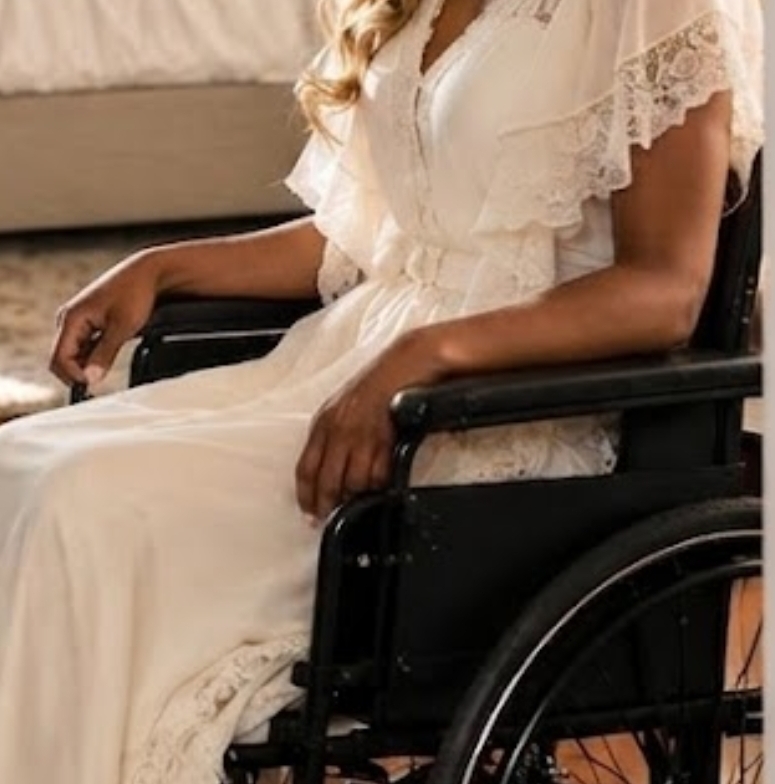
The envelope in my hand bent under my fingers. I looked again at the wheelchair in the living room, at the crumpled blanket, at the untouched medication tray. For ten days I had imagined nothing. I had forced myself to imagine nothing. Not Lauren struggling to reach a glass of water. Not Lauren calling my name in the empty house. Not Lauren staring at the front door, waiting for footsteps that never came.
Now every image attacked me at once.
“Is she?” I whispered.
Daniel’s face changed. Not softened exactly, but something in it shifted, as if my fear had arrived too late to mean anything.
“Yes,” he said. “She’s alive.”
The relief hit so hard I had to put one hand on the back of the sofa.
Alive.
The word should have saved me. Instead, it only opened another door to fear.
“Then where is she?”
Daniel looked toward the kitchen table, where the papers were spread in neat, damning piles. “Read the letter.”
“I’m asking you.”
“And I’m telling you to read what your wife wrote before she left this house.”
Before she left.
The phrase made no sense. Lauren could not leave without help. She could barely stand without me supporting her on one side. The idea of her simply leaving the house while I was away felt like a cruel trick.
I lowered my eyes to the envelope.
My name looked the way it always had in her handwriting—careful, slanted slightly to the right, the letters pressed firmly into the paper. She used to leave notes on the refrigerator for me before the accident. Don’t forget your presentation folder. I made soup for dinner. Good luck today. Love, L.
There had been a time when coming home to her handwriting made me smile.
Now it felt like a hand closing around my throat.
I pulled out the folded pages. There were three of them.
The first line blurred before I could read it.
Marcus,
By the time you find this, I will already be somewhere you cannot reach me by walking down the hall and saying my name.
I stopped.
My hand shook once, hard enough to rattle the paper.
Daniel said nothing.
I forced myself to continue.
I waited for you for two days before I understood you were not coming home early. I waited through the third day because I told myself you must have been delayed, busy, overwhelmed, anything other than the truth my heart already knew.
On the fourth day, I stopped waiting.
Not because I stopped loving you.
Because I finally understood that loving you had become a place where I disappeared.
I closed my eyes.
The house was silent except for the faint hum of the refrigerator.
“She wrote that when?” I asked.
“Keep reading,” Daniel said.
I looked back down.
You left my medication where I could see it but not always reach it. You left food in the refrigerator I could not safely prepare. You left your promises scattered around this house like old receipts.
For the first day, I was angry.
For the second, I was afraid.
After that, something inside me became very still.
I realized that if I survived your absence, I would never again confuse dependence with devotion.
The words cut deeper because they were calm. There was no screaming on the page, no dramatic accusation, no begging. Only a tired clarity that made my excuses sound childish before I could even speak them.
I turned to Daniel.
“You found her?”
His eyes narrowed. “No. She found us.”
“What does that mean?”
“It means she called my mother.”
I stared at him. “She couldn’t reach the phone from the bedroom.”
“She didn’t call from the bedroom.”
I frowned. “What?”
Daniel took one step into the living room. His gaze dropped to the wheelchair. “She crawled.”
The word landed harder than anything he had said.
I looked at the stretch of floor between the couch, the hallway, the kitchen counter where the landline sat. The distance seemed enormous suddenly. I imagined Lauren pulling herself across it with one working arm, her hip dragging, her breath shallow, her hair sticking to her face, stopping to rest on the cold floor tiles while the phone sat waiting above her like a mountain.
“No,” I said, but the word had no strength.
“Yes,” Daniel said. “She crawled from the bedroom to the kitchen because you didn’t answer your phone. Because nobody else knew she had been left alone.”
“I thought—”
He took another step toward me. “Don’t.”
His voice was not loud, but it stopped me instantly.
“Don’t tell me what you thought. Don’t tell me you planned to come back. Don’t tell me you were stressed, or scared, or tired. Everybody gets tired, Marcus. Everybody gets scared. Most people don’t abandon someone who can’t get herself a glass of water.”
I looked away.
On the coffee table, one of the medication bottles had rolled slightly out of line, its white cap catching the light. I remembered filling that tray the morning I left. I had told myself ten days would pass quickly. I had told myself Lauren slept most of the time anyway. I had told myself she could manage more than she admitted.
All of it had been an arrangement of lies carefully stacked to make room for Olivia.
“What happened after she called your mother?” I asked.
Daniel’s mouth tightened. “Mom called me. I came here. I found her on the kitchen floor.”
My knees nearly gave.
“Was she hurt?”
“She was dehydrated. Weak. Her blood pressure was low. She had bruises from dragging herself around. But mostly she was quiet.”
Quiet.
That was what broke me most.
Lauren had always gone quiet when pain became too large. Not because she had nothing to say, but because she believed words should not be wasted on people determined not to hear them.
I looked down at the letter again.
Daniel and Mom came for me. They wanted to take me to the hospital first, but I asked them to bring me one thing from the bedroom before we left: the old blue folder from the bottom drawer of your desk.
You probably forgot what was inside it.
I did not.
My breath caught.
The blue folder.
I remembered it with a sudden chill. Insurance forms. Copies of financial accounts. Password notes I had once written down because Lauren handled most of the household budgeting before the accident. Afterward, I had taken over everything. Or pretended to. The truth was, I had let bills pile up and moved money around without telling her, always assuming she was too exhausted to notice.
But Lauren had noticed everything.
She always had.
In that folder, I found what I needed. Not only documents. Patterns.
I found hotel charges you said were business meals.
I found cash withdrawals that lined up with evenings you told me you were working late.
I found messages on the old tablet you thought no one used anymore.
And I found the name Olivia.
My face burned.
Daniel’s eyes stayed fixed on me, as if he were watching the exact moment a man met himself for the first time and disliked the introduction.
I swallowed. “Lauren knows?”
“She knew before you left for Asheville.”
I stared at him.
“No,” I said. “That’s not—”
“She knew.”
My fingers tightened around the pages.
I remembered the morning I left. Lauren had sat by the window in the bedroom, wearing the cream sweater she liked because it was easy to pull over one shoulder. Her hair had been tied loosely at the nape of her neck. I had told her the retreat was mandatory. I had told her the company needed me there. I had told her I would call every night.
She had looked at me for a long second and asked, “Do you have everything you need?”
I had said yes.
She had smiled faintly, but not with happiness. I had not understood that smile then.
Now I did.
I read on.
I wanted to ask you before you left.
I wanted to say her name out loud and watch your face.
But part of me was afraid that if I asked, you would lie gently enough that I might believe you. And I could not survive another gentle lie.
So I waited.
Not for you to choose me.
For me to choose myself.
I sat down on the edge of the sofa because my legs could no longer hold me.
The room around me felt altered, as if the objects had turned into witnesses. The framed photo from our second anniversary sat on the bookshelf. Lauren in a green dress, me with one arm around her waist, both of us smiling at a future we thought belonged to us. A glass vase on the mantel held dried flowers from the hospital room, flowers I had forgotten to throw away. Beside the window stood the small side table where Lauren used to drink tea in the mornings while reading novels.
Every corner of the house contained a version of her I had left behind.
“What does she want?” I asked.
Daniel’s expression hardened again. “That’s in the letter too.”
I turned the page.
I am not writing this letter to punish you.
I am writing it because for three years, I trusted you with the softest parts of my life. Then, after the accident, I trusted you with the hardest parts too. That was the mistake that almost ended me.
I will not make it again.
I am safe.
I am with people who know how to love without needing applause for it.
Do not come looking for me tonight. Do not call my mother. Do not call Daniel. Do not call hospitals. Do not call pretending your panic is love.
Tomorrow morning, you will receive a call from my attorney.
My attorney.
The words looked unreal.
I glanced at Daniel. “She’s divorcing me.”
He did not answer.
There are things we need to settle. The house. The accounts. The insurance. My care. The debt you hid from me. The promises you broke.
I will speak to you when I am ready, with someone else present.
Until then, I need you to do something you have avoided for a long time.
Sit in the silence you created.
Lauren
I reached the end and kept staring at her name.
Lauren.
Not “your wife.” Not “love.” Not even the small L she used to sign when she was being tender. Just her name, complete and separate from mine.
The silence she mentioned seemed to swell around me immediately. It filled the living room, pressed against my ears, exposed every corner of me I had tried not to see.
Daniel picked up a manila folder from the kitchen table and placed it on the coffee table in front of me.
“What’s that?” I asked.
“Copies,” he said. “Everything Lauren wanted you to have tonight.”
I looked at the folder but did not touch it.
“I need to see her.”
“No.”
The answer came so quickly it stunned me.
“Daniel, please.”
“No.”
“I need to apologize.”
Daniel’s face twisted, not with rage, but with something almost like grief. “You think an apology is a key? You think you say the right words and doors open?”
“I’m not saying that.”
“That’s exactly what you’re saying.”
I stood, too quickly, and the room swayed. “She’s my wife.”
“For now,” he said.
The phrase struck with surgical precision.
For now.
I looked at the wedding ring on my finger. It had felt invisible for days. Now it felt heavy enough to bruise.
“I made a mistake,” I said.
Daniel’s eyes flashed. “A mistake is forgetting an appointment. A mistake is taking the wrong exit. You made a series of choices, every day, for months. Then you left her here and hoped the house would hold her until you were done pretending.”
His voice cracked slightly at the end, and for the first time I saw something beneath the anger. Fear. Real fear. The kind that had already imagined a worse outcome and had not yet recovered from it.
“She could have died,” he said quietly.
I had no answer.
Because it was true.
The sentence moved through me slowly, without mercy.
Lauren could have died in this house while I sat across from Olivia in a restaurant lit by candles, laughing at some story I could not even remember. Lauren could have died while I ignored my phone. Lauren could have died while I told myself I deserved a break.
I pressed my palms against my eyes.
“I didn’t think it would get that bad,” I said.
Daniel let out a breath. “That may be the most honest thing you’ve said. You didn’t think.”
The front window reflected the living room behind me. I saw myself in the glass, shoulders hunched, shirt wrinkled from travel, face pale and older than it had been that morning. For ten days, I had mistaken escape for freedom. Now I understood that I had only delayed the moment when truth would find me at home.
“Where is she staying?” I asked.
Daniel’s expression closed. “Somewhere safe.”
“With your mother?”
“Marcus.”
“I just want to know she’s okay.”
“She’s better than she was.”
That answer hurt more than I expected.
Better than she was meant better away from me.
Daniel moved toward the hallway and picked up a duffel bag I had not noticed before. It was mine, packed and zipped.
“What is that?”
“Some clothes. Toiletries. Your laptop. Lauren asked me to make sure you didn’t have a reason to go into the bedroom tonight.”
“You’re kicking me out of my own house?”
“No,” Daniel said. “Lauren is asking for space in the house she also owns, and I’m making sure you understand that request.”
“I have nowhere to go.”
He stared at me.
The irony needed no explanation.
I looked away first.
Daniel set the duffel by the front door. “There’s a hotel off Route 9. Or your office. Or Olivia’s.”
The name made me flinch.
Daniel noticed.
“Does she know?” he asked.
“Know what?”
“That the fantasy ended when you opened the door.”
I said nothing.
Olivia had texted me twice during the drive home. I had not answered. At the time, I told myself it was because I needed to think. Now I realized I had been protecting the last fragile seconds before consequence.
Daniel walked to the kitchen table and began gathering some of the papers into a neat stack.
“She won’t speak to you tonight,” he said. “Don’t try.”