
You Probably Know This Nut by Sight—But Its Real Name and Surprising Story May Take You Back
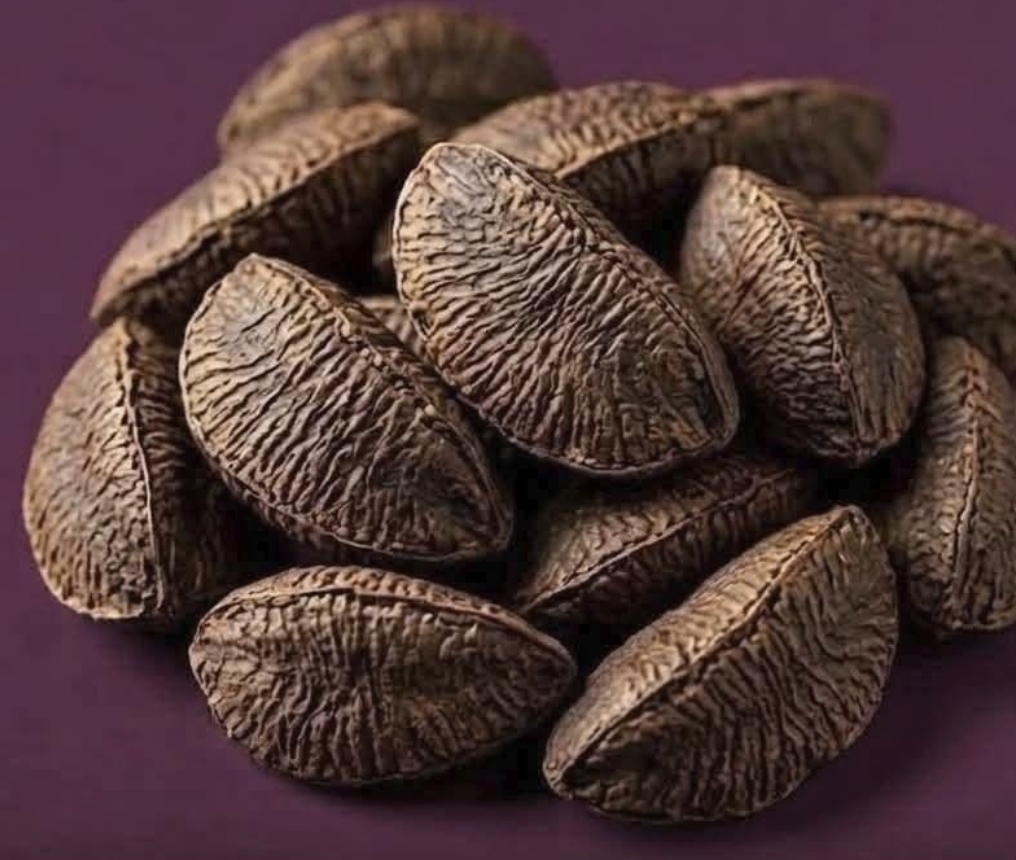
If you grew up seeing a bowl of nuts still in their shells around the house, especially during holidays, the objects in this picture might instantly trigger a memory.
Get Organic Produce
Maybe your grandmother kept them in a wooden bowl on the kitchen table.
Maybe there was a heavy metal nutcracker beside them.
Kitchen & Dining
Maybe you remember trying to crack one open as a child, only to discover that the shell was far tougher than you expected.
And depending on where you grew up, your family may even have called them something completely different.
But what exactly are they?
The photograph appears to show Brazil nuts still in their hard shells. Their rough, elongated, wedge-like shells are characteristic of Brazil nuts, which are the seeds of the Amazonian tree Bertholletia
excelsa. USDA inspection guidance describes the
Download Nature Guides
nuts as having a triangular shell shape because multiple seeds develop packed together inside a much larger fruit.
Get Organic Produce
And once you discover how these unusual nuts actually grow, that strange shape suddenly makes perfect sense.
They Don’t Grow Individually Like You Might Imagine
continues on the next page.
Seeing an individual Brazil nut in its shell can make you picture dozens of them hanging separately from tree branches.
That’s not what happens.
Get Organic Produce
The Brazil nut tree produces an enormous, hard fruit that can resemble a woody coconut.
Inside that fruit are numerous individual Brazil nuts arranged tightly together.
USDA inspection guidance says a Brazil nut fruit can measure roughly three to eight inches across and may contain approximately 12 to 30 nuts. The way those seeds are packed together helps explain their distinctive angular shape.
It’s almost like opening a container and finding a collection of
smaller armored packages inside.
First you have the
Order Gardening Supplies
extremely tough outer fruit.
Get Organic Produce
Then each edible kernel has its own hard shell.
Only after removing that second shell do you reach the familiar pale Brazil nut sold in bags at supermarkets today.
For anyone who remembers cracking these by hand, buying them already shelled can feel almost like cheating.
Your Grandmother May Have Known Them as Something Else
This is where the nostalgia gets interesting.
Foods often acquire regional and family nicknames that get passed down without anyone stopping to ask where the name originated.
Order Meal Kits
Today, Brazil nut is the standard English name, while in Brazil you’ll encounter Portuguese names such as castanha-do-Pará and castanha-do-Brasil.
So if your grandmother had another name for them, that doesn’t
necessarily mean she was referring to a different food.
It may simply reflect where she lived, what her parents called them, or terminology common during
her childhood.
That’s why photographs of old-fashioned foods
can generate hundreds of comments from people confidently giving completely different names for the same thing.
Download Nature Guides
The Tree Behind Them Is Remarkable
Brazil nuts don’t originate from a small orchard tree.
Trees
We’re talking about a huge Amazonian forest species.
USDA material describes Brazil nuts as coming from large trees in the Amazon Basin, with production associated mainly with Bolivia, Brazil and Peru.
Traditional harvesting is also unusual.
When mature fruits fall from the tree, they’re collected from the forest floor. USDA inspection guidance describes the pods as being gathered after falling and then opened so the individual nuts can be removed.
That makes the bag of Brazil nuts sitting in a grocery store
look rather different once you know where it began.
But Their Most Famous Feature Is Hidden Inside
Crack through the brown shell and you’ll find a large, creamy kernel.
Order Gardening Supplies
Its texture is richer than many other nuts.
That’s partly because Brazil nuts naturally contain substantial amounts of fat.
Join
But nutritionally, Brazil nuts have become particularly famous for something else:
selenium.
Selenium is an essential trace mineral, meaning the body needs it—but only in relatively small quantities.
USDA sources describe Brazil nuts as exceptionally rich in selenium, while also noting that the actual amount can vary significantly depending on geographic origin.
Snack Foods
That variability is important.
This isn’t a case where “more is always better.”
Because Brazil nuts can contain so much selenium, they aren’t a food you need to consume in huge quantities to obtain the mineral.
Why Does Selenium Matter?
Selenium participates
in important biological functions, including antioxidant-related enzyme systems and normal thyroid function.
Find Chemistry Tutors
That’s partly why Brazil nuts have developed a modern reputation as something of a “superfood.”
But that label can be misleading.
Fruits & Vegetables
They’re nutritious food—not medicine.
continued on the next page’
Eating Brazil nuts doesn’t detoxify the body, cure
diseases, reverse aging, or provide the miraculous effects sometimes attached to them in social-media posts.
Their real nutritional qualities are interesting enough without exaggerating them.
USDA researchers describe nuts generally as providing plant protein, fiber and predominantly unsaturated fats, with different varieties contributing different combinations of vitamins and minerals.
Brazil nuts happen to stand out particularly strongly for selenium.
Join Snack Clubs
Because Brazil nuts can be so selenium-rich, eating handful after handful every day isn’t necessarily a smart strategy.
Selenium is essential, but excessive long-term intake can be harmful.
nutritional advice around Brazil nuts tends to emphasize moderation rather than treating them like an unlimited snack or supplement.
And because selenium concentrations naturally vary from nut to nut and region to region, it’s difficult to assume that every individual Brazil nut provides precisely the same amount. USDA nutritional material specifically notes
Get Organic Produce
this geographic variability.
So when you see a
social-media post claiming that exactly one, two, or three Brazil nuts will produce some guaranteed health transformation, be skeptical.
Nutrition isn’t usually that precise.
The Shell Itself Tells You Something
Look closely at the picture.
Those deep grooves and thick brown surfaces aren’t decorative.
They’re armor.
Join Snack Clubs
Commercial grading standards for in-shell Brazil nuts actually pay attention to the condition of these shells.